Apartment List~4 min read
A written-off segment got four weeks to prove itself.
Four weeks, one engineer, a PM who left mid-project, and a segment already written off once.
- Role: Product design and research
- Timeline: 4 weeks
- Team: 1 engineer, 1 PM until they left, me (design + product)
- Impact: $50k → $350k revenue
- Platform: Web
Segment revenue
up from $50k
Reporting adoption
up from 2%
Renewals
up from 20%
I set these targets, and Sales and Finance produced the figures. They were read at three weeks, ahead of the three months Apartment List normally took, and held through the rest of my time there, to 2024. Revenue is run-rate rather than cumulative. Still missing: the account counts behind the two percentages.
Overview
I tested whether a written-off segment was low value or had never been given a product.
Apartment List had treated small and mid-market landlords as noise for years, because enterprise brought the revenue. When enterprise growth stalled, the company wanted a second source of growth in four weeks.
I co-led the work with a PM, who left one week after discovery ended. I carried product direction alone from there.
Worked with: 1 engineer; a PM until a week after discovery; Sales, revenue, and Finance stakeholders; 6 subject matter experts and 6 partners in research.
What I owned
I owned
- The reframe: that the segment’s numbers were measuring a product it had never been given
- MVP scope, and the decision to scope it so that a bad result would still be readable
- The build-versus-buy audit, and the case for a lean MVP over the proposed property management system
- Research with 6 subject matter experts and 6 small-business partners, plus Sales, revenue, and Finance stakeholders
- The reporting rebuild
- Product direction after the PM left, including the metric targets
Shared with the engineer
- What was feasible in four weeks
- The anonymization that made the market view shippable at all
Research
The numbers behind the write-off measured a product the segment had never been given.
The segment showed 30% retention, 80% churn, and 2% reporting adoption. Nothing had been built for this segment, so 2% adoption described use of something that barely existed. Churn was measured against workflows the company had logged as edge cases.
I led research with 6 subject matter experts and 6 small-business partners, plus Sales, revenue, and Finance. The partners’ message was consistent: they wanted to see more of how their listings performed.
Before
Retention
Churn
Reporting adoption
Retention and churn were each read over three weeks, in different periods, so they do not reconcile as opposites. Neither is an annual figure, and exactly when each was taken is not in the record.
Decision: MVP scope
I built a lean MVP around one workflow so a bad result would still tell us something.
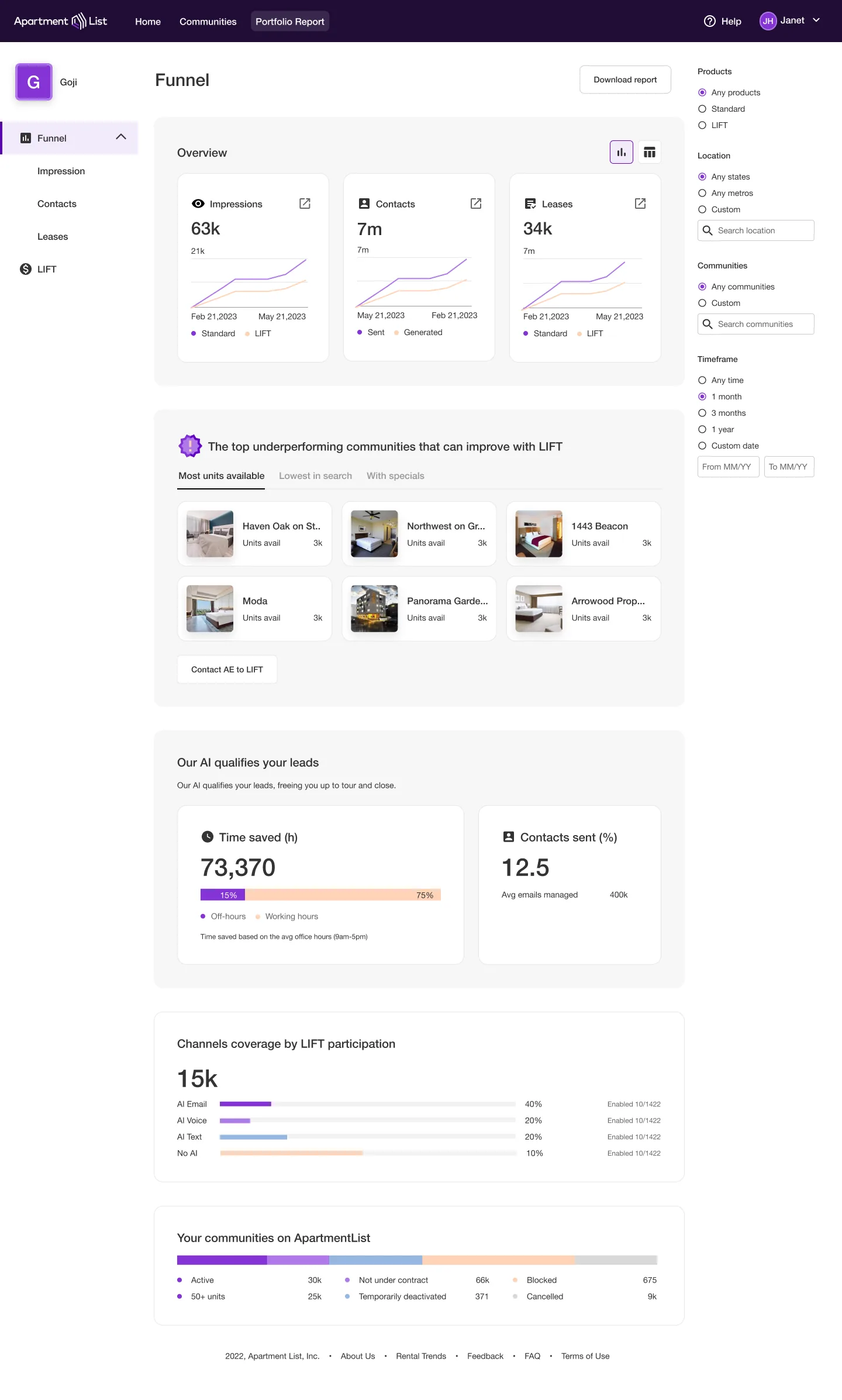
The options were a full property management system, buying and integrating one, or a lean listing MVP. An audit of core versus differentiating features put the full system at multiple quarters with heavy technical-dependency risk. That left the lean build or no test at all.
I spent the four weeks on the one workflow partners called blocking. If they ignored it, demand was missing. If they used it, the old numbers had measured coverage. The cost is that a narrow MVP says nothing about the workflows it left out. A second bad number would have closed the question for good, on thinner evidence than it deserved.
Redesign
Four fixed reporting views, chosen from research, replaced a configurable dashboard.
After the PM left, nobody was left to settle which metrics mattered. A configurable dashboard would have pushed that disagreement into the product.
The four views cover trend clarity, comparative performance, actionable recommendations, and retention-risk signals. They came from the 12 research participants rather than internal preference. Fixed views fail anyone whose question is missing. The first iteration was rejected as costly to build and hard to understand. The second shipped.
Scope
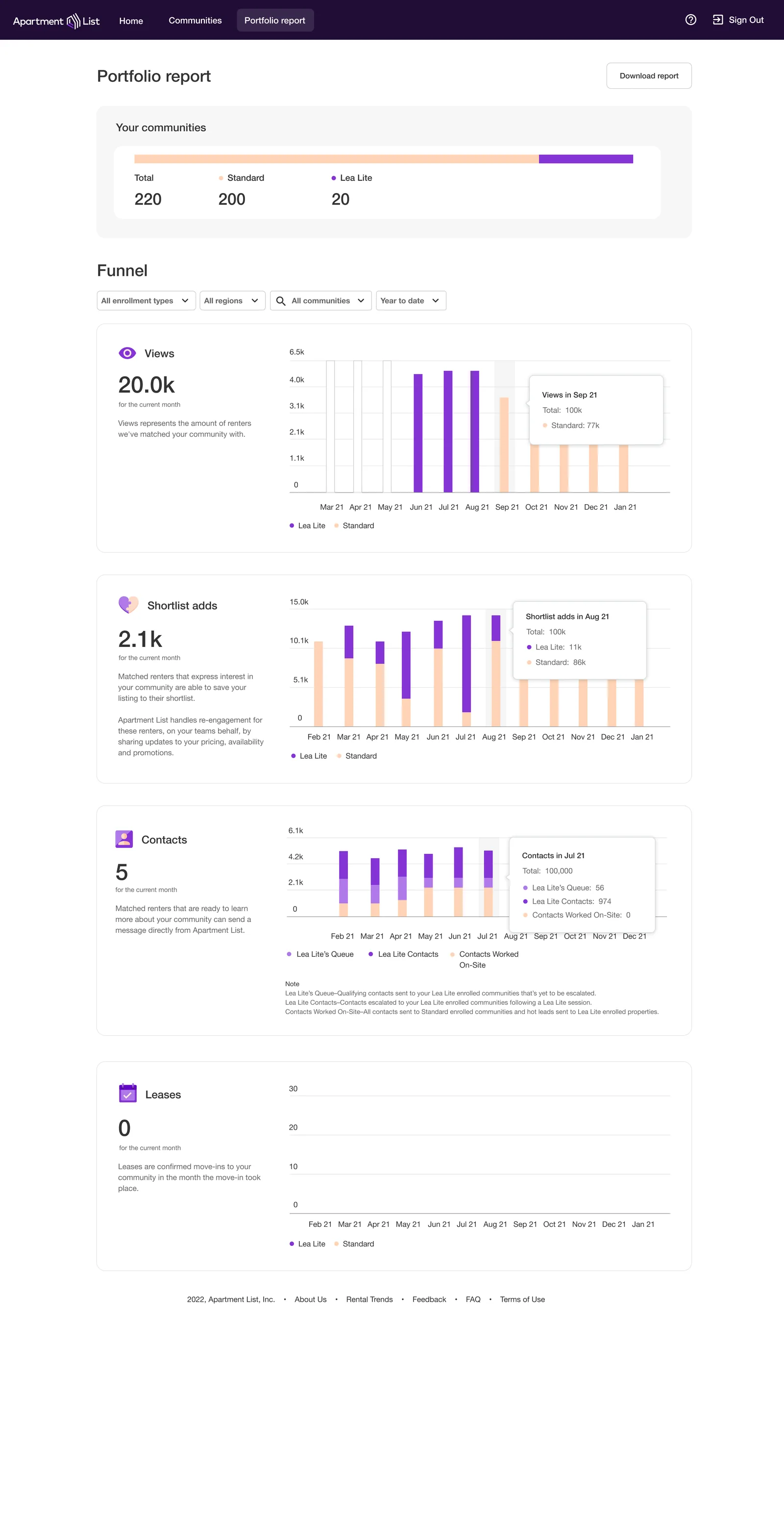
The listing MVP and four-view reporting shipped, and the named market view was cut for privacy.
The named view exposed identifiable partner information, including personal data partners had no right to see. I shipped anonymized benchmarks instead. They are a commodity. The named version was the reason a partner might have opened the tool weekly, and nothing replaced it.
Also cut: the full property management system, and any configuration by partners.
Results
Revenue, adoption, and renewals all rose, but I cannot separate my work from the market.
Enterprise growth stalled during this work, and Sales had its own reason to sell into the segment. I do not know how much of the change belongs to each.
One result is a change in perception, with no measurement behind it. The company stopped treating the segment as low-value. I cannot say how much of that came from my work and how much from the same market pressure.
I cannot show what persuaded anyone to fund the reframe
My record holds the conclusion, not the argument. The funnel map set the MVP scope and the interviews set the four views. But four weeks of an engineer’s time probably owed as much to enterprise stalling at the right moment as to anything I presented.
If I had scoped the MVP too small and it had failed, the write-off would have become permanent, with better evidence behind it.