Preqin~7 min read
An AI routing engine anyone could overrule.
Ops staff had zero trust in AI routing. The override log is why they accepted it anyway.
- Role: Product strategy and design
- Timeline: 3 months
- Team: 1 PM, 1 engineer, me
- Impact: Ticket turnaround down 75%
- Platform: Web

What changed
Ticket turnaround
six months, down to about six weeks
Revenue
up from 10%
Renewals
up from 5%
All three from the portfolio deck, read over the two weeks after launch, the same window as the other Preqin work. The 75% is turnaround time: against the six-month ticket turnaround in the before row, that is roughly six weeks. They are not the same kind of claim: turnaround is an operational measure of this tool, while revenue and renewals are business outcomes on a platform this tool served from the inside. Attributing the second two to an internal operations system takes a chain of reasoning (healthier data, fewer stale records, better retention) that I have not written down and that nobody instrumented. Read the efficiency figure as the result of this work and the other two as context around it.
The model was not the hard part
Preqin sells data, and 60% of it was unhealthy at any given time. Accounts touched by stale records were three times more likely to churn, and a ticket took six months to turn around. There was no system underneath any of it: people found, prioritized, assigned, chased, and tracked the work in Excel.
We built the company’s first AI-powered operations platform, a routing engine that assigns tasks and priority scores from historical patterns, individual expertise, and team bandwidth. What made it shippable was not the model. It was giving anyone the ability to overrule it, then logging and feeding back the override.
Three things stayed contested: the routing itself, the progress bar, and the launch date. Nobody was persuaded on any of them, and it shipped anyway.
What I owned
I owned
- Product strategy and design end to end
- User research and the operations journey map
- Framing the opportunity and the constraints
- The MVP definition, and the two directions that failed before it
- Rapid testing across the iterations
Shared with the PM and engineer
- What the routing model could infer from historical patterns
- The launch timing dispute, which neither of us settled: see the note
Problem
When data operations break down, what do they cost besides time?
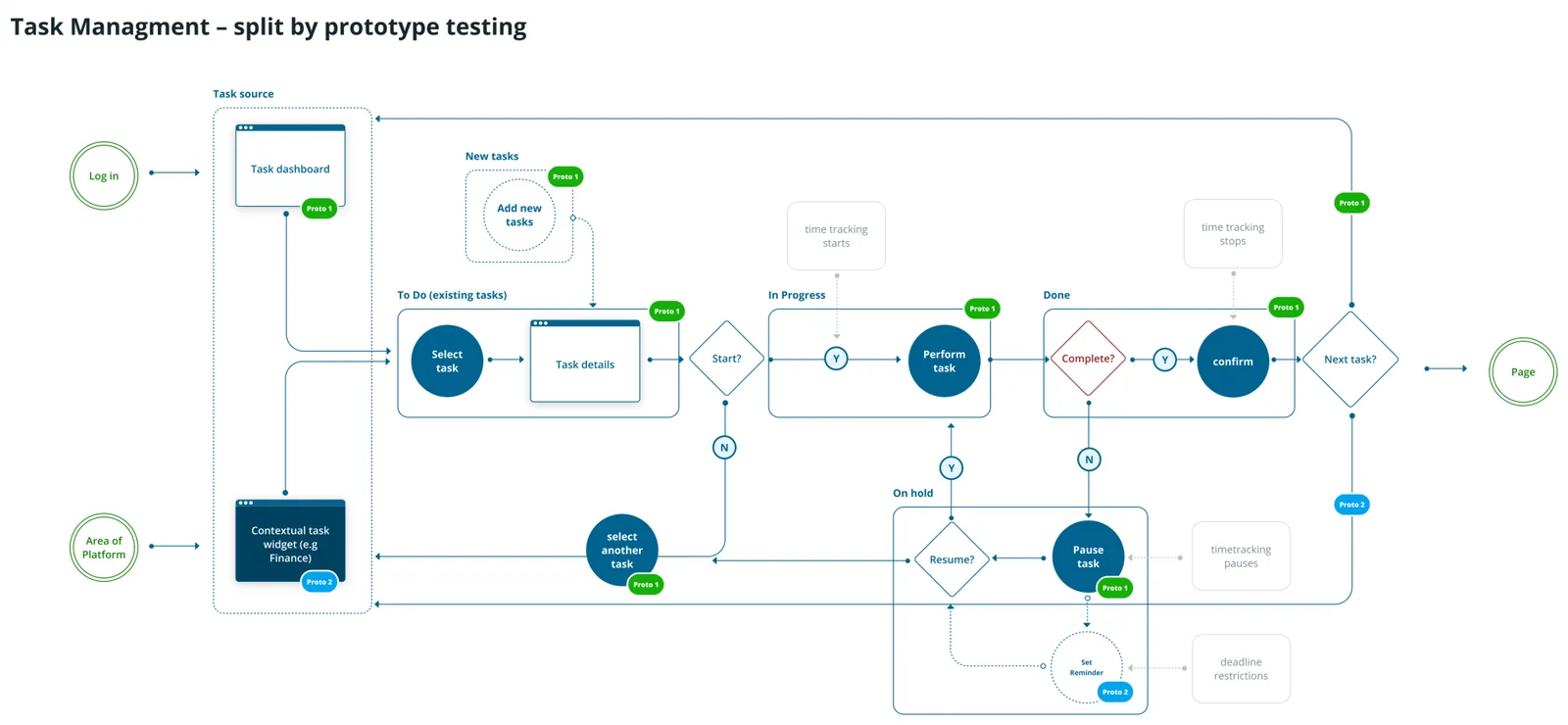
A job that should have been one step took twelve: find data to update, prioritize it, create tasks, assign them, coordinate the people doing them, wait on a data check, call Sales to identify a client, wait for Sales to call that client, publish, then track it all in Excel.
Research surfaced three problems, none about the interface. Workflows and systems were disjointed. No one could see the work’s state. And nothing was tracked anywhere the team could act on it.
Before
Unhealthy data
Ticket turnaround
More likely to churn
From the deck’s problem slide. The churn multiple applies to accounts affected by stale data; the population it was measured across is not recorded.
Eleven steps of coordination
Twelve steps to update a record, and only one of them was the update.
Eleven of those steps are coordination wrapped around one step of work. Nobody in operations was slow at their job; the job had been surrounded by handoffs, and every handoff was a place for a ticket to sit.
That is what decided where the intervention went. A faster interface makes the one step quicker and leaves the eleven alone, which is why the previous tooling had capped out. Routing attacks the coordination directly: if the right person gets the right task with a priority already attached, most of the eleven stop existing rather than getting faster.
It also explains why this had to be an AI problem at all, which is not a sentence I would write for most projects. Assigning work well requires knowing who is good at what and who has capacity right now, across a queue nobody could see the state of. That is a judgement people were making badly from a spreadsheet, not a workflow anyone could hard-code.
The engine changed. The surface did not.
Could we change the process without making ops learn a new one?
We could build a streamlined new interface, patch Excel incrementally, pay incentives for completed work, or iterate on the experience ops already had. Operations were mid-collection cycle throughout, so learning a new way of working competed directly with the work it was meant to speed up.
I iterated on the existing experience. That risked capping improvement at the old workflow's limits, so the routing engine sat beneath the existing surface: the process could change without making the interface unfamiliar. Data collection got faster without a training programme.

Kanban looked good. The split panel worked.
Why did kanban lose to a split panel?
We considered a kanban board, split panel, and list with detail navigation. Kanban tested well on paper for this workload, but risked slowing the workflow and was unfamiliar to non-technical operations staff.
I chose a split panel for speed and decision-making. Its density echoed what the previous tool had failed on, so the routing engine's priority score ordered the left-hand queue by what mattered. It mapped to the existing workflow. A second, priority-sorted iteration still failed: it fit the team's system but left them unable to see each other's work, which the third version fixed.

An override on every assignment
What made AI routing acceptable to ops?
Assignment could be fully automated, cut back to suggestions someone accepted by hand, or automatic with every override logged. Operations had zero trust in AI routing: “If the AI messes up in routing tasks, who’s accountable?” and “I won’t use it unless I can change what it assigns.”
I used automatic assignment that was always overridable, logging every override and feeding it back to the model. The log records what happened but doesn’t answer accountability; if a wrong route goes uncaught, it only records that nobody caught it. Priority scores appeared with assignments so people could see why they received work before accepting it. The system routed automatically and was used; accountability remained unresolved, while the design conceded control.
What actually shipped
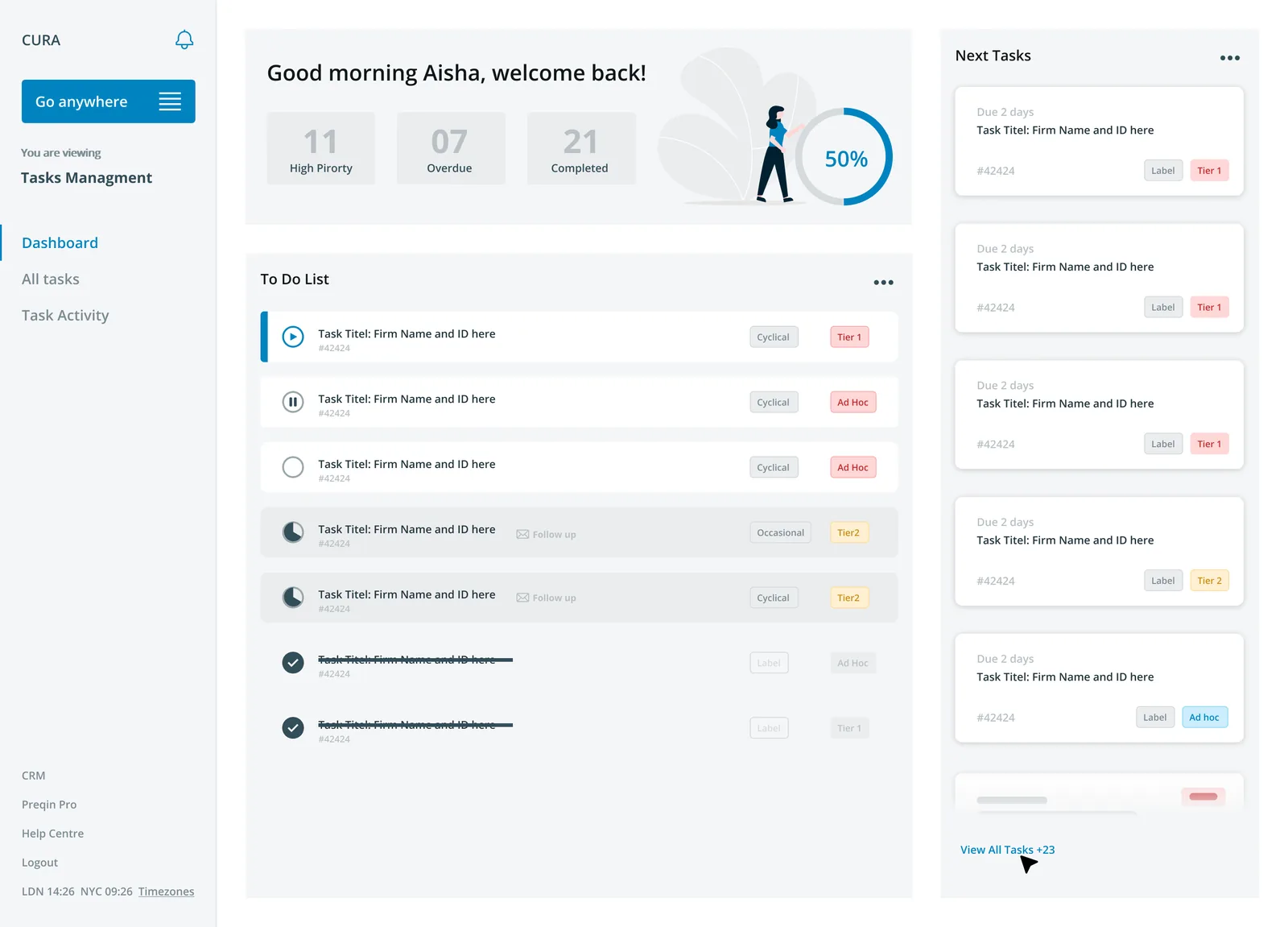
Automatic routing to the right person, with a priority score and an override on every assignment. A progress bar for quick visibility into work in flight. Flags for what needed attention first.
Deferred: the data-input surface. It stayed in the team’s existing system, which kept them where they were and meant some work was entered twice.
What outlasted the tool
The durable outcome wasn’t on the dashboard. Before this project, the product organization did not define measurable business-success metrics for what it built. Setting them here is what made that the practice, and that outlived the routing engine.
Two smaller things carried forward. The override log means the model improves on operations’ own corrections, so the concession that got it accepted is also the thing that makes it better — the team never has to have the adoption argument twice. And putting the change in the engine rather than the surface turned out to be repeatable: the routing could be retuned repeatedly without anyone in operations noticing a new interface, which is the only version of iteration available to a team that is mid-collection-cycle all year.
What operations was actually asking for
Operations didn’t need the routing to be right. They needed it to be reversible.
Every objection I got was about control and none was about accuracy. Nobody asked how good the model was, or for a confidence figure, or to see the training data. They asked who was accountable and whether they could change what it assigned.
What I do differently since: on an AI feature I spend the design budget on the reversal path before spending it on the model’s presentation. Accuracy buys nothing until somebody is willing to let the thing run, and a system that is reversible gets adopted at an accuracy people would have refused outright if it were final. The override log is the part I would repeat everywhere — it turns the concession into a training signal, so the price of getting adopted is also what makes the model better.
What it does not do is settle accountability, and I want to be exact about that because it is the thing an override log is most often assumed to fix. A log records that nobody caught a bad route. It does not say who should have. That question was open when I left and the note below is about it.
The launch happened without agreement
Operations never came around to AI routing. They accepted a system they could overrule, which is different. The override log recorded what happened, not who was accountable when a wrong route went uncaught.
Engineering called the progress bar gimmicky scope creep. It shipped because the second failed iteration had lacked visibility into work in flight, though I don’t know whether Engineering changed its view. The ops manager wanted to wait a quarter; the PM had promised Q3. They piloted instead, and what the pilot established was narrower than agreement: once people could watch an AI system managing the team’s schedules, the value was legible enough to launch on. That is what got it shipped. It is not the same as ops trusting the routing, and nobody changed their mind about who was accountable when a route went wrong.